• BLOG
  • ABOUT
  • Menu

writing to survive

. . . only the retelling counts
  • BLOG
  • ABOUT
BLOG RSS

The stuff of my childhood, delicious Swanson Hungry Man dinners.

Culinary ghosts

January 15, 2026 in Memoir, What we ate and why

I am working on a large, complex research and writing project. Nervous about getting too much of it out there or writing in more depth about the topic, but here is something I’ve been working on around it recently. Definitely a work in progress of a work in progress.

My mother’s 1970s health food phase is a long-running family joke. Heavy on the health, low on the taste. She was not an anomaly—those food coops we were a part of didn’t come out of nowhere—but it wasn’t until recently that I realized how much of her cooking was part of being a young person in the wake of the ‘60s. The realization hit me during a conversation with my hairdresser. We’re the same age, ladies in our fifties, our facades beginning to crumble, our childhoods part of the Gen X tough-it-out mythos. As we were admiring her latest attempt at taming my increasingly wiry hair, we talked food. “My mother was 19 when she had me,” she told me. “There wasn’t a lot of money, and she wasn’t the best cook. Everything was ‘healthy,’ made with honey. And carob didn’t really cut it.”

Though my hairdresser is from in the Bay Area and I was born on the East Coast, our childhood experiences were similarly carob- and honey-laden. However, my young mother, also 19 when I was born, wasn’t a bad cook. She was culinarily curious, interested in trying things out. The health food focus was part of that curiosity, an illustration of her “nuts and berries” (as a great aunt sardonically put it) hippie-ish ethos. Our kitchen had Diet for a Small Planet alongside Julia Child’s Mastering the Art of French Cooking (Volume 1), James Beard’s books, and the Victory Garden Cookbook. Recipes clipped from the newspaper were sometimes tucked into the pages along with the occasional pressed leaf or flower, the books’ margins penciled-in with cooking tips in my mother’s looping script.

I grew up primarily in a single-parent home with my grandmother playing a lead supporting role. Mom-mom took care of me on long weekends and the random snow day or school strike. I spent long lazy summers with her and my grandfather at their “California-style” ranch located near Maryland’s Elk River. I even lived with them for most of third grade when my mother returned to college. In these early years, my father, a meat and potatoes man, was an intermittent presence. Care and feeding were the responsibility of the maternal side of the family.

These were lean, difficult years. My mother worked a series of underpaid menial jobs until she graduated from college in the early 1980s and moved on to a series of underpaid writing and editing jobs. Despite our poverty and her general overwhelm, I don’t remember ever going hungry, except on those nights when I was sent to bed without dinner, a parenting disciplinary technique born out of desperation. Besides, my grandmother was always there to pick up the slack in more ways than one, those ways being heavy on the hydrogenated oils and daytime television, the hum of her Singer sewing machine threading the gaps.

What were my grandmother’s feelings about food and meal prep? The fragmentary evidence would indicate that she did not love to cook, though she was expected to do so. I mainly remember the delicious processed food she prepared, apart from her less-delicious vegetable soup, made up of scraps of frozen this and canned that. She was born in 1914 and came of age in the immediate aftermath of the Great Depression. These years overlapped with huge changes in the way Americans ate, with easily available frozen and canned foods and the growth of food conglomerates and mass marketing. New food technologies pared down food preparation time, freeing up time for other things, such as sewing, poker games with her friends, or The Price is Right. Dinner at her house, served at 5pm sharp, was occasionally of the TV variety, served on TV trays while we watched TV. It was slightly easier living made better through (food) chemistry.

That was childhood, a back-and-forth conversation of souffles, honey, and Hungry Man Salisbury steak. Then my grandmother abruptly ended the dialog. She crumpled in front of me on her kitchen floor, groceries melting on the counter. I was nine years old, in the middle of fourth grade. The conversation abruptly became one-sided—until it petered out entirely.
Tags: food traditions, family meals, 1970s food, Swanson Hungry Man dinners, 1970s health food, Generation X childhood food memories, carob

Ghost in the office.

In the absence of an other

November 24, 2025 in On writing, On therapy

I used to have a fire burning within me, a desire to dive deeply into my professional work as a psychotherapist. I wanted to write articles, supervise trainees and interns, have my website at the top of every relevant internet search, to become trained in various modalities, to deepen my understanding of what makes people tick and what helps them to change.

Perhaps it was the pandemic or just the accretion of experience, but those professional fires are currently banked. I continue to be invested in the importance of deep connection and the healing possibilities of a caring, attentive therapeutic relationship. I am devoted to my clients. But I feel like so much of the noise around psychotherapy, the idea that specific actions can universally initiate change, the desire to replicate training programs to mainly line the pockets of other clinicians who charge big bucks for certification, the focus on diagnosis – I feel like it’s getting us wrong. It underestimates human nature, culture, how we are embedded in time, and how these forces intertwine.

Rejecting substantial bodies of psychological research can be a dangerous position for a therapist. Relying on some ineffable magic about the therapeutic relationship, perhaps putting all the spark in the therapist themselves, leads to a loss of perspective that can be harmful. I do not reject all research on effective therapeutic techniques or see therapists as shaman or gurus. What I do recognize is that what is transformative about the type of therapy I practice is hard to capture. It emanates from a collaboration between me and the client, allowing for deep listening, responding with compassion, slowing things down, reflecting, working through ruptures, and containing and processing pain and shame. It involves the creation of a third space, an overlap between the client and myself, while also allowing for our separate experiences. Psychotherapy done in this way is a deliberate, delicate, and careful process that creates space for people to bloom into and accept their full, messy selves.

That’s what I try to do, though it can get tricky when dealing with clients across the developmental spectrum from childhood to middle age. The expectations of connection and the methods to get there are different depending on life stage and, like any person, I am more “successful” with some than others. My ambition as a psychotherapist has been whittled down to a room with two people reflecting on the beauty and suffering endemic to the human experience, asking questions about how to live. How do we make our way forward in this damaged world? How do we accept ourselves and be fully present? Sometimes this process takes place in words, sometimes in the creation of art, and sometimes using games and play.

While my psychotherapeutic ambitions have shrunken to the intimacy of the therapeutic relationship, my writerly ambitions are beginning to fire up, though with a similarly small approach. I recently committed to writing every day for at least 15-20 uninterrupted minutes. Using a timer, I ignore my frequent urges to look things up. I let my fingers fly. The result has been a torrent of words as I sort through thoughts and feelings I did not know I had. This is step one of my re-entry into something resembling being a writer. Eventually I want to include more narrative, long-form based writing, but just getting the engine started is a good for now.

Unlike almost everything else I do, writing is based on my needs. Since the concept of writing for a reader can itself be constraining, leading to a performative flexing of writing chops that can result in flash and falseness (like this sentence!), I am attempting to leave the reader’s potential needs and interests out of it. My current ambition is just to write, to build a truly creative life that is not dependent on anyone else. Of course, being a writer does imply having an audience (hello wts reader!), but I don’t want that to influence what I take on. My daily writing is for me alone. I write in this blogging space for myself and others. Perhaps as I string other narratives together, something meant for public consumption will emerge more regularly.

My psychotherapy work is a private creative act. Much of my writing is a private creative act. I suppose it could lead to something, but this is not, cannot be, the main driver. I am a woman in a room by myself, creating a shared experience in the absence of an other.

(As I was cleaning up this draft, I read an email promoting a writer’s retreat. My heart sped up. The images of community came involuntarily. So maybe I am protecting my ambitious, creative self by claiming no desire for an audience. Just have allow myself to be as I am in this moment.)

No way out but through

October 24, 2025 in The struggle redefined

This is the truth of it. I am 56 years old. My husband is nearing 60. My remaining parent will be 76 next year. There is young blood in the house, our 20-year-old son, who is grappling with what the youth of today must grapple with, disconnection, lack of joy, low expectations of this melting, fetid world. Alone, together, we live in a no-outsiders urban outpost.

I did not expect to feel so isolated at this stage in life. I’m not truly alone. We’re not alone. But our ties to each other are all we really have. They are deep, meaningful, singular, and insular. And they are all the boy has right now, this small clutch of hoary eggs thudding against one another in a brittle, aging basket.

I am ashamed of this isolation. It is an old shame. Who wants to show such congenital loneliness, inadvertently passed on to the next generation? I have friends. They are spread out, some more present in my current life than others, all from earlier days. But the boy is no longer in touch with peers and seems to believe he has nothing to offer. My husband, the more affable of our group, is also mainly without outside connection after two significant losses. Our small families have been pared down to a loose set of four with the occasional visitor.

There was a time when I wanted to be in the world. I pursued connection. Maybe it’s the emotional heft of my job, the responsibilities of my private life, or the reemergence of depression (recent bouts of controlled crying, hopeless outlook). I find it hard to make time and space to pursue new relationships or maintain old ones. Who has the energy? Who has the interest? It’s safer in this fading basket.

Someday I may pay the price. I may be the sole survivor of the marriage, the boy far away. Or the boy and I will hole up in the house until he, too, is alone. My current solution to this looming problem is to cultivate what I imagine to be a Buddhist-like sense of removal and acceptance, courting low expectations, normalizing solipsism. Many a hermit, a solitary soul, has survived this world. I can enter the flow of humanity outside my doorstep and re-enter my solitude at will (someday). It’s the boy, the young man, who worries me. Now is the time to build a life, not to hunker down with the oldsters.

Even in this relatively anonymous format, I feel uncomfortable writing about it. This no-longer child, intelligent, thoughtful, somewhat emotionally aware and sensitive, a focus of my writing in the early days (was it my depressed parenting that caused him to withdraw from the world?) – it is his life to figure out. And figure it out he will. He will. Most of me knows it.

What to do with this loneliness, my mind folded around ghosts? What to do to create meaning out of this all too human experience? I always return to creativity and perhaps confession, the lure of a writing life. Even that elusive bonbon has been sucked of its sweetness by artificial intelligence and electronic distraction, the mass of humanity in the grasp of glowing screens, pulled into a liminal space of image, shadow, and illusory escape.

Consider this my fight against hopelessness.

(“No way out but through” is from the Robert Frost poem A Servant to the Servants. “The best way out is always through” is the more commonly quoted line, but I prefer this one. The poem is a long and odd one, more appropriate to the topic of this post than I expected.)

Remnants

September 11, 2025 in Life goes on

He will never read this. That’s not a crime, just a fact. And I will not go cycling or ask about what he is reading, nor will he ask me about my books or the inner workings of my mind.

I am sharp-tongued, impatient and pushy, sardonic and quick. He takes his wounds silently and quietly retreats, his vulnerable parts protected, unexcavated, safely out of reach.

I cook. He does the dishes. I complain, he (mostly) listens. He drives. I ride. We share a surreal sense of humor and, often, a telepathic sense of what the other is going to say next. We have formed together, each growing around the other, our unused bits and pieces atrophied. Dormant. This is the way of all long relationships, I suspect.

It is neither good nor bad. It is not exactly a choice, though we could have chosen differently. But sometimes I am aware of what lies hidden, the heartbeat of emotion, thickened veins of want thrumming with need. Over time, it becomes harder to access what we’ve left behind.

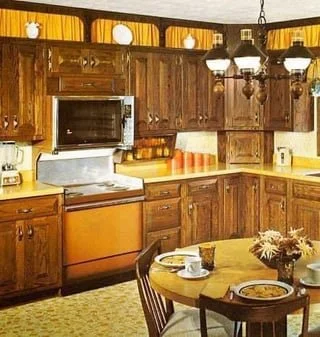
Not the kitchen of my early childhood, but close enough.

Nostalgia is a creative space

August 29, 2025 in Out of the past

I can’t get away from the past, yellow Formica countertops, tobacco-stain brown pine cabinets, cooktops in harvest gold, burners coiled like snakes. I walk the spongy carpet to the louvered doors, breathe in the cool, mildewed conditioned air. This synthetic world of cigarette smoke and formaldehyde made me. I am sawdust and Coffee Mate, vinyl and Butterick’s sewing patterns.

Forty years on, on the opposite coast with its own arid form of nostalgia (Eichler and Eichler-adjacent, plywood walls, all right angles and walls of glass, the occasional built-in interrupting the room), I tap through real estate ads from my Mid-Atlantic homeland. It is as familiar as ice cream scooped out of a cup with a wooden spoon. There are green expanses of lawn, muddy riverbanks, Colonial brick center hallway wallpapered wonderlands. Rooms are sparse with overstuffed easy chairs that sink into wall-to-wall, buck’s heads unblinking over boxy brick fireplaces.

I knew this place once. I came from it, a thistle emerging from rows of seed corn. And then I moved to the Bay Area, a land of rugged beauty. I made my own drama. I ached for something else and then settled into what was. But nothing is as fertile as that starting place. The key to creativity lies in nostalgia.

Tags: nostalgia, 70s nostalgia
Prev / Next

writing to survive

. . .  only the retelling counts