Education of an impostor

At sleepovers, I deconstructed entire linen closets. I would sneak into the hallway, a child prowler working by nightlight, and seek out the towels, fabric-softener-fresh mounds of richly hued terrycloth, thick and plentiful. At home our towels were hodgepodge and pale, thin and stained. Inexpertly folded. We put them in haphazard stacks, shoved them in the bathroom cabinet or never even bothered to put them away, passed the spinach souffle over them at the dinner table. I observed the technique of those in the folding-know, took the stacks apart, unfolded and folded until it became second nature. The trick was to fold the towels evenly in thirds lengthwise, then fold the result in half and in half again. It was the kind of skill one learned at a mother’s side, like ironing or playing poker or throwing chaotic birthday parties.

Because folding is the metaphor, see? For domestic knowledge and stability. For normalcy. When you don't feel normal and want to fit in, you observe and try to copy. Everything is a clue to the right way to behave. Nobody needs to know that you are an impostor.

loveringavetwirl


Last night my small book group met to discuss Michael Ondaatje's novel Divisadero. It's a flawed book, or at the very least a book that requires both careful reading and a lack of attachment to resolution. I was the only one who really enjoyed it. Yes, the characters are damaged and abandoned, solitary types with hidden motivations. But they are my people, sketched out in Ondaatje's poetic language. I can't be the only one who knows how to fill in the blanks.

What I can't get from careful observation, from cracking open other peoples' linen closets, I get from books. Stories show me the possibilities in life. Sometimes I know the characters, fellow strangers in a strange land. There is solace in the world of quiet ones, solitary bookish people trapped in the amber of personality and circumstance. Freedom is possible. Maybe it is as simple as self-acceptance and if there is hope for them, there is hope for me. Or maybe there is no hope and I should just get on with it.

“All my life I have loved traveling at night, with a companion, each of us discussing and sharing the known and familiar behavior of the other. It’s like a villanelle, this inclination of going back to events in our past, the way the villanelle’s form refused to move forward in linear development, circling instead at those familiar moments of emotion. Only the rereading counts, Nabokov said. So the strange form of that belfry, turning onto itself again and again, felt familiar to me. For we live with those retrievals from childhood that coalesce and echo throughout our lives the way shattered pieces of glass in a kaleidoscope reappear in new forms and are songlike in their refrains and rhymes, making up a single monologue. We live permanently in the recurrence of our own stories, whatever story we tell.” -- Michael Ondaatje, Divisadero, p. 136.


Without stories, I would be a series of events
waiting for an author, searching for a unifying theme. Without memory, the raw material of story, I am nothing. But a strange thing can happen when we start to tell our stories, to mix memory with narrative: the stories can change. We can change. Our past can drop away, defanged.

I am here to gather the pieces and make them into something new, a narrative, a mutable monologue: this is who I am. If I'm lucky what I write will spark something in you.

Maybe it's time for another story.
|

Join one sentence with another


confetti1


For about eight months now, I've been taking a course at
The Writing Salon called the Round Robin. Once a week the instructor, Jane Underwood, sends a class email with that week's writing prompts and partner assignments. Every day, for no more than twelve minutes, my partner and I each write on that day's prompt, sending the resulting "writes" to each other by email. Occasionally, the prompt is a photograph. Usually it is a phrase (yesterday's was "I feel exasperation tensing my face"), sometimes just a word.

The point is to just do it, to see what happens when we let our words flow without forethought or editing. Each partner responds to the other's work, pointing out the things that they like, encouraging the good. The process is exhilarating and a little scary. I read the prompt, gnash my teeth, and then start typing, not knowing where I'll end up.

And where I end up often surprises me. Mainly I divert my thoughts from real life, bored with the worn roads of
me, well-traveled and devoid of wildlife. The words don't tumble, exactly, they waltz, softshoe onto the page, join me at a leisurely pace. I start with one sentence, join it with another, and before you know it, I have a story. A vignette.

Like this one, so different from what I write here.

Writing prompt: The test

It’s nothing. Just a blank sheet of paper, 8.5 x 11 inches. The doctor passes it to me. I stare at one of the desk legs, slit my eyes until the carpet and wood blend together, a fuzzy field of sand and tree.

Did she mention what I am supposed to do with the paper? Is that the whole point of this test, to see how I react? Origami isn’t my thing, doc. I can’t even fold a paper airplane. And I am not up to folding a cootie catcher. The idea makes me smile, though, a cootie catcher with various diagnoses hidden underneath the flaps, with pictures of clowns and crazies decorating the outside. Pick a number, say the riddle, figure out the problem.

The sheet of paper sits there, like a command: Do something. So I do. I grab it and growl, start ripping, take what I’ve ripped and rip through that as well, doubling, tripling the thickness of the paper until I can’t rip anymore. By now I’m stomping around her desk, going in circles. I take what remains of the paper and toss it into the air, cackling as the confetti drops around us.

I sigh, sit down. “I feel
so much better. Thanks, Dr. Krapinski.”

She offers me a cigarette.

Image from here by way of I Am the Cheese.
More on cootie catchers.

|

Marked by heavy hands

The world you’re plunked into is the one that will hold. Certain odors will stick: melted cheese transformed into a crisp filagree along a sandwich edge; stewed tomatoes, metallic as tarnished silver, bleeding into a wedge of macaroni and cheese. Smoke spirals from a cigarette, a dark-haired Bob Barker waits with a sanguine smile as the announcer orders another contestant to “Come on down!” In the warmth of her grandmother's bed, a little girl watches To Tell the Truth, the air conditioner stopping and starting in the humidity of an Eastern Shore afternoon.

cigarette


This is the sensory soup of childhood. It is a mix of family and location, of bad luck and lucky streaks. We continue the pattern with our own children, begin the silent lessons, mark them with heavy hands: this is who you are, who we are. Whenever my son smells oatmeal pancakes or plucks a plump blueberry from a glass bowl, the past will live. "You Are My Sunshine" will conjure up a darkened room, my soothing cuddle against impertinent wakefulness. He may spend years in therapy trying to get my voice out of his head, only to find that same voice coming out of his mouth in middle adulthood.

I can only hope that his experience is as painless as growing up can be. Sometimes my best won’t be good enough.

I remember being seven, lying on that flowered couch in my grandparents’ family room, my hand sunk into a plastic bag full of cherries. Cold from the manufactured air, goose-pimpled, I clutched a pillow for warmth. The television, which was as much a piece of furniture as an entertainment device, was showing Fred Astaire and Ginger Rogers in
Top Hat.

That night I would have another asthma attack, whether it was because of mildew, cat hair, cigarette smoke, or my own melodramatic emotions is up for debate.

Image: Me and my grandmother, Hollywood Beach, 1973.

|

Diversionary tactics

fortfunston2

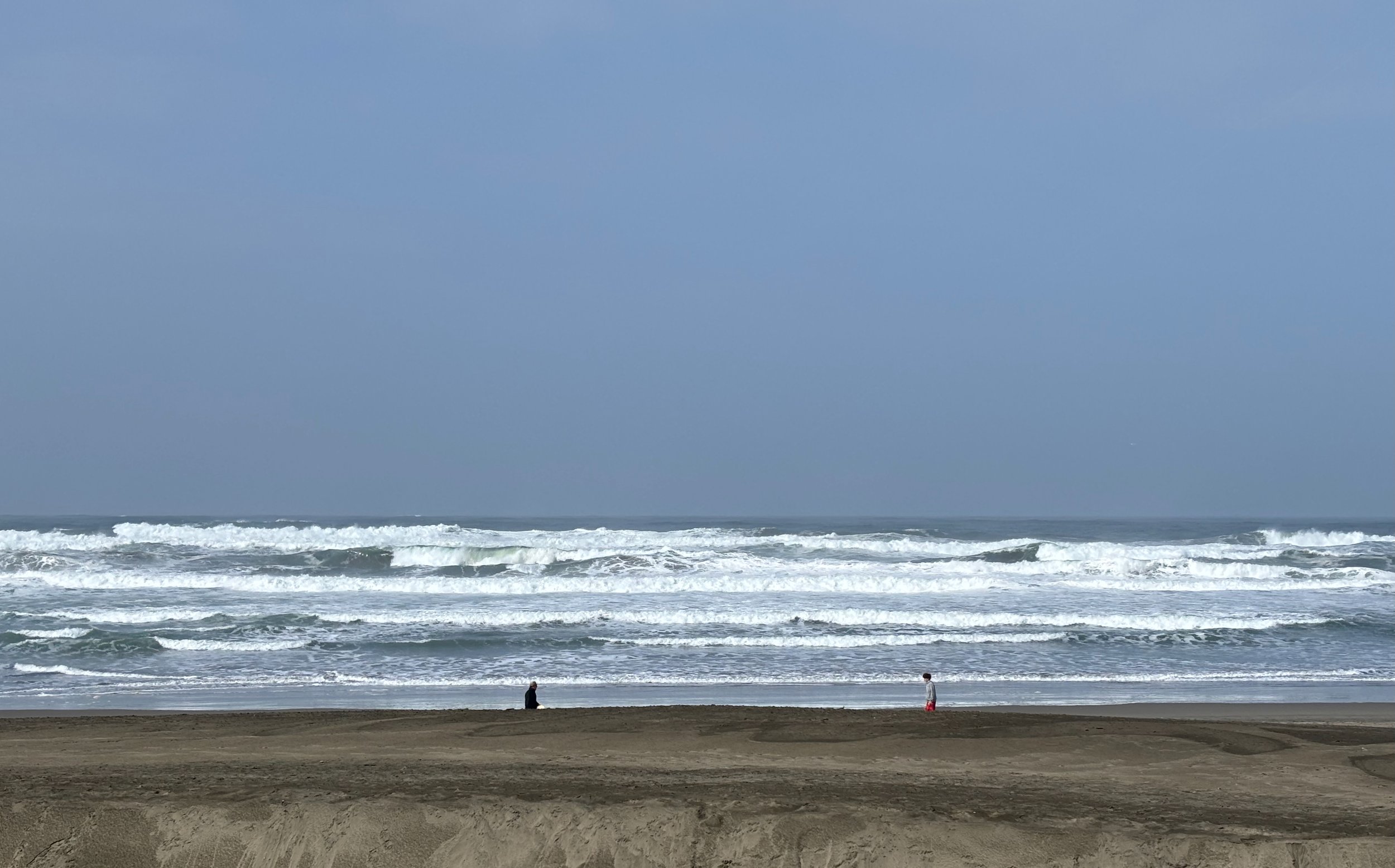
Don't be disturbed by the photograph. It is only a diversion. In fact, I actually posted it a couple of weeks ago and then removed the post. I had nothing to say and the photograph wasn't adding to the conversation. Today it appears as filler, a little piece of San Francisco scenery. Or maybe it works as metaphor, too, though as a metaphor for what you'll have to be the judge.

Last night I was walking home from my food writing class, feeling energized and full of something (beans? ideas? hope for the future?) when I realized that I have a commitment problem. I've been circling working life for almost five years now, keeping decisions on hold, tossing words into the air. I fumbled into my first career, became a librarian almost by default, then stumbled when making what felt like a deliberate move into the world of cooking. And I've been floating with the current ever since.

I have to commit or I'll keep on writing 450 - 800 word posts here forever and ever. It's not a bad gig, though the pay is lousy. I love interacting with my blogging friends. But I need something more substantial. A career.

Do you know what I mean?

For your trouble, your time, maybe as a reward for leaving a comment, here's a recipe. Consider it another diversionary tactic or maybe just some picnic food for your next visit to
Fort Funston, the hang gliding mecca.

Herbed feta and tapenade sandwiches


Briny tapenade and thyme-spiked feta punch up the flavor of this Mediterranean sandwich. A couple of simple tricks -- adding a sprinkling of herbs and olive oil to a supermarket cheese, roughly chopping a handful of olives with a touch of garlic – give it an effortless homemade touch. Bring extra bread along to sop up red pepper juices and the occasional escapee feta tidbit.

Makes 2 sandwiches

1/2 cup kalamata olives, pitted and roughly chopped
1 small clove garlic, minced
2 tablespoons mayonnaise

1/2 cup feta cheese, crumbled
1 tablespoon fresh thyme leaves, minced (can substitute 1 teaspoon dried)
1 tablespoon extra virgin olive oil
pinch freshly ground black pepper

4 slices country bread
1 small cucumber, peeled and thickly sliced
1 large red pepper, roasted, seeded, and quartered


Stir together kalamata olives, garlic, and mayonnaise in a small bowl. Lightly toss feta, thyme, olive oil, and black pepper in another small bowl. Slather each slice of bread with a generous amount of tapenade and layer the feta, cucumber, and red pepper on two of the slices. Top each sandwich with the remaining bread, slice in half, and serve.

Image: Hang gliders at Fort Funston, Memorial Day 2009. Photo by "Mr. Trinkle."

|

Beware of Estonians bearing basil *recipe not included*

emptyarm


Peter was only after the blender.


I was working in the college bookstore, propped up on a stool behind the register, when he came in to buy something small, a pack of gum, a used book, a cassette tape, I don’t remember. As I passed his change over the counter, brushed my fingertips across this stranger's calloused palm, Peter said “I know you from the newspaper. You told it like it was.”

A month earlier I was one of five or six people chosen to answer a question for
The Elm: what did we think about the proposed student fee increase? Below my photograph was the statement “I know nothing about it. I have no opinion.” Ignorance and flat honesty prevailed. It was my statement, my stand on nothing in particular that got me the boy.

Or maybe it really
was the blender. After asking my name and relationship status, Peter went straight to appliance ownership: if I had the blender, he had the basil. He knew where to score pine nuts and a fine wedge of pecorino romano. Peter wanted to come back to my place, make a little pesto.

The blender sat on the stained linoleum kitchen counter in the small college apartment I shared with my roommate Martha, right beside the coffee percolator that she filled with Folgers each morning. Martha bought it with plans for soup-making, warm vichyssoise in winter, refreshing gazpacho during the humid summer months, but in reality we used it make frozen drinks. After the Piña Colada incident the appliance went fallow, gathered cooking grease and flour dust.

Peter's basil source was a garden across the Chester River, a plot of rich soil courtesy of his employer, Anthony's Landscaping. We rode there one sticky June night, pedaled his tandem through a landscape defined by moonlight and shadow, moved our legs in time to the percussion of crickets. The basil had formed a moat around a pair of tumbledown beefsteak tomatoes. Rabbits and groundhogs had ravished the rest. As I smoothed my fingers over the soft leaves, pale in the semidarkness, the basil sighed, let out a breath of spice and earth and warm sun, a promise of pasta sauce and anise-tinged kisses.

basilgreen

When you are 18, most of the world is still a mystery, or it should be. I already had a boyfriend, and Peter knew it, but something about his earnestness – his habit of tossing rocks at my window for midnight bike rides, the fact that he was as aimless at 24 as I felt at 18 – made him irresistible. He was an English major whose literary mind had been muddled by deconstructionism, an Estonian-American who later taught me the best places to go in Washington, DC for Ethiopian food and the blues. Peter liked to pass things on. It was insider information: the slightly off-kilter notes of Thelonius Monk; the tuneless pounding and punk bands of d.c. space; the Biograph movie theater; linguini with pesto sauce.

His pesto obsession was endearing. And it
was an obsession. In circa 1988 Chestertown, Maryland, pine nuts were an exotic foodstuff. Without a car, Peter had to finagle his way 75 miles and back to DC to procure one expensive cupful. He arrived at our place on the appointed night, clutching two bouquets of basil, a greasy paper bag half-filled with pine nuts, and a crumbling hunk of cheese. Martha and I had already peeled the garlic, purchased a good-enough olive oil. We had wiped down the blender. In the kitchen, I started grating cheese while Martha opened beers. Peter began tossing pine nuts and knobs of garlic into the machine.

The blender turned out to be an inferior pesto-making tool, or perhaps it was all in the technique. Crammed in the bottom, the garlic and pine nuts slowly turned to paste, while the basil calmly refused to be pulled into the fray. Peter finally grabbed a wooden spoon. The high-pitched whine of the blender was interrupted by a thunk as the bottom of the spoon splintered against metal blades. Too late to go back now. He picked out the shards.

Twenty minutes later, Peter offered a fingerful of the final product. Eyebrows raised in anticipation, I kept a cheerful expression, gazed past the green film coating his glasses to look directly into his eyes. The pesto tasted of garlic and more garlic interrupted by a heady nip of basil and the punch of sharp cheese. Raw pine nuts, resinous and rich, just barely kept the other ingredients in tune. As olive oil ran down my chin, I carefully deflected a splinter with my tongue, a little kick from Peter's secret ingredient.

(First image: Me, Chestertown, MD, Summer 1988, taken by "Martha." Companion picture of Martha not included. Second image: Basil plants, from Vultus Christi.)

|